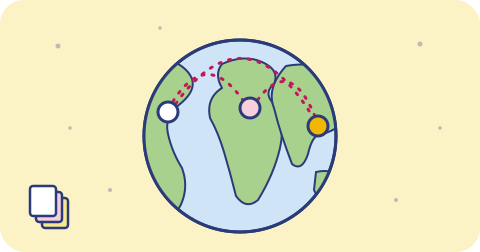
The 3-2-1 rule asks for one copy off-site. For a home user, “off-site” might mean a relative’s house across town. For a business, it often means a cloud bucket in another city. This post makes the case for going further, putting one copy on a different continent with a different storage provider, and is honest about what that costs.
What can take out a whole region
Cloud providers build their regions to be resilient, with multiple data centres (availability zones) spread across an area. That protects well against a single building failing. It protects less well against events that affect a whole region or a whole provider.
Regional outages
Every major cloud provider has had incidents where a whole region, or a key service in a region, was degraded or unavailable for hours. The causes vary: configuration mistakes, software bugs, networking problems, power or cooling failures. Data is usually not lost in these events, but you may not be able to reach it when you need it.
Natural events
Floods, cyclones, earthquakes and heatwaves can affect a whole metropolitan area. Data centres are built for this, but a severe regional event can still disrupt power, networking and staff access at the same time.
Network disruption
Much of the internet traffic between continents travels on undersea cables. Cable cuts happen from time to time, and repairs can take weeks. Traffic is usually rerouted, but with more latency and less capacity.
Provider risk
Geography is only half of it. A single provider is also a single point of failure in ways that have nothing to do with location:
- Account problems. A billing dispute, an automated fraud flag or a compromised admin login can lock you out of every region at once.
- Software bugs. A bug in a provider’s storage system or control plane can affect many regions together.
- Business changes. Providers change prices, retire products and change terms. Rarely, they shut down.
Keeping copy 3 with a different provider means none of these can take out both of your backup copies together.
Two regions of the same provider protect you from geography. Two providers protect you from the provider. A different continent with a different provider protects you from both.
The trade-offs
Distance is not free.
Latency
Light in fibre is fast, but continents are far apart. Round trips between India and Europe or the United States are commonly in the range of 100 milliseconds or more, compared to a few milliseconds within a city. For backups this is mostly fine, because backups are large sequential transfers rather than many small interactive requests. But it does mean:
- the far copy is usually written asynchronously, so it may lag the near copy by minutes or hours
- restoring from the far copy is usually slower than restoring from the near one
That is why the far copy is your insurance, not your first choice for everyday restores.
Cost
Moving data between regions and providers can incur transfer charges, and storing a third copy is more storage to pay for. For personal data the amounts are small; for large business datasets it is worth planning.
Complexity
Two providers means two sets of credentials, two monitoring setups and two places to check when something goes wrong. A good backup service hides most of this from you, but someone has to manage it.
Data residency
The obvious question for Indian users and businesses: is it acceptable to have a copy abroad at all?
For personal data, India’s DPDP Act generally permits transfer outside India except to countries the government notifies as restricted. Some sectors, such as payments, have stricter rules that require data to stay in India. Contracts with enterprise or government customers may also specify location.
Practical approaches:
- Keep the near copy in India where it is fastest to restore and under Indian jurisdiction.
- Choose the far copy’s country deliberately, and know which provider and jurisdiction it falls under.
- Encrypt before the data leaves, so the far copy is unreadable without your keys, wherever it is.
- If a regulation requires India-only storage for some data, keep that data out of the far copy, or choose a design that meets the rule. Get advice where needed.
When a far copy may not be worth it
- Data you could easily recreate or download again.
- Very large, low-value datasets where the extra storage and transfer cost outweighs the risk.
- Data that a regulation or contract requires to stay in one country.
For everything else, especially irreplaceable photos, business records and databases, the far copy is cheap insurance.
A checklist for your own setup
- ☐ Where is each of your backup copies, by city and country?
- ☐ Are any two copies with the same provider, under the same account?
- ☐ Could one compromised password delete every copy?
- ☐ Is at least one copy encrypted with keys you control?
- ☐ Do you know how long a restore from the far copy would take?
- ☐ Are there any regulatory or contractual limits on where data may go?
Closing note
This is the design behind triplicate: copy 2 in your home region and copy 3 on another continent with a different storage provider. You choose from storage locations in dozens of cities across six continents, including Mumbai and Hyderabad in India. See every country and city.
Keep reading
What every restaurant should back up (and how often)
Ledgers, billing data, GST records, supplier bills, aggregator payouts, licences and staff records. A plain list of what a restaurant should back up, where it usually lives, and how often to copy it.
Organising bills, receipts and warranties so you can find them when it counts
Thermal receipts fade, GST invoices get lost and warranty claims need proof. A simple system for Indian households to keep bills findable for repairs and ITR.
Test your restores: an untested backup is a hope
Backups fail quietly. A practical routine for testing restores at home and at work, what to check, how often, and what to write down.